In Antipolo City, what began as early learning is now taking root as leadership in climate advocacy. Children who once learned about climate risks are now stepping forward. These young advocates are now facilitating sessions, guiding younger peers, and speaking up in their communities. Keith, 12, a grade 6 member of Green Eco Warriors, is one of them.
Like many students’ nearing elementary graduation, Keith was managing multiple schoolwork at once. But when Green Eco Warriors decided to prepare a presentation on climate risk and available services during emergency situations for younger children in their community, she and her peers made it a priority.
“At first, we found it difficult to work on the script, but since we were doing it for younger children, we made sure that it would be enjoyable for them,” she said. For Keith and her peers, this was not just a simple school activity. They took ownership of planning, writing, and delivering a child-led campaign on climate resilience for children.
During their sessions, the group used storytelling, games, role-playing, and visual materials to explain climate change, disaster preparedness, and available services in ways younger participants could understand. Some activities were conducted in classrooms, while others were done in smaller group settings to encourage participation. Through these sessions, the Green Eco Warriors reached more than 300 children across eight schools in Antipolo City, demonstrating how peer-to-peer engagement can make learning more accessible and meaningful.
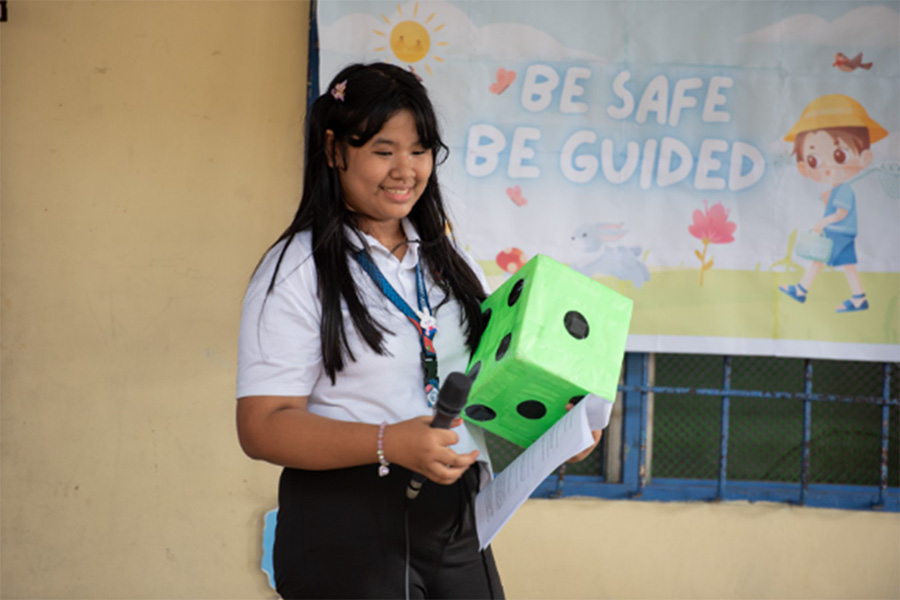
Keith, 12, a grade 6 student from Antipolo City, facilitates an interactive session, using dice to engage children in learning about climate risks.
As they planned their sessions, the group also intentionally made them inclusive. Their teachers mentioned that some children have disabilities, including those with hearing difficulty and those in special education. Instead of proceeding as originally planned, they adapted their approach. “We didn’t want anyone to be left out. It should be inclusive. Whether your vision is limited or you have a disability, we made sure you could still be part of the activity,” Keith said.
They incorporated basic sign language and adjusted their facilitation methods. In doing so, the children were not only sharing information but also designing activities that responded to their peers’ diverse needs and allowed them to engage meaningfully.
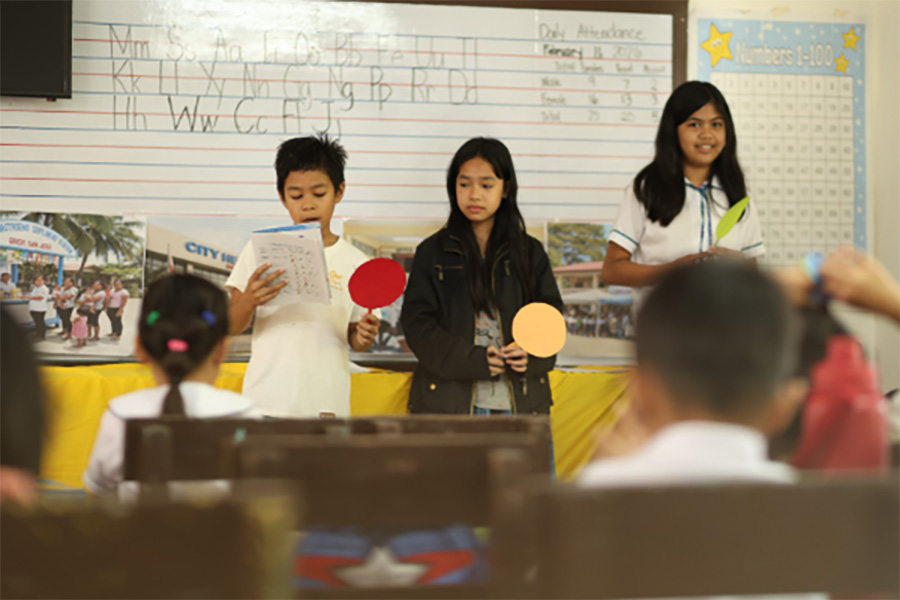
Members of the Green Eco Warriors use color-coded icons to help younger children identify and access services before, during, and after a disaster.
This becomes even more important during emergencies. Disasters are unpredictable, and some children may feel afraid or distressed during flooding or typhoons. By sharing information on available services in schools and communities, children are better able to identify who they can approach for support.
These experiences in awareness raising campaign built their confidence and strengthened their sense of responsibility as peer facilitators. Some children shared feeling proud that they could teach others, while others saw their role as helping pass knowledge forward. The confidence they developed also enabled them to engage beyond their group. During a dialogue with the local government, members of the Green Eco Warriors presented issues affecting children in their communities, including safety risks, damaged infrastructure such as the bridge they cross to get to school, and access to services during disasters.
For many, it was their first time speaking directly to decision-makers. They described feeling nervous, but also proud to represent other children. “I was happy because the voice of the youth was finally heard,” a child shared.
Following the dialogue, local government representatives acknowledged the children’s concerns and committed to actions, including improving waste management practices to reduce flood risks, reviewing infrastructure design, and creating regular spaces for consultation with children.
Keith’s experience reflects a broader shift taking place in Antipolo. Children are no longer just participants in programs. They are becoming facilitators, advocates, and contributors to community discussions.
The Green Eco Warriors believes that no one should be left behind, especially during disaster and emergencies. Through their actions, children are showing how inclusive and resilient communities can be built.